The Stipend Strategy: How Private School Teachers Can Earn an Extra $40,000
How strategic thinking—not a higher salary schedule—can add more than $40,000 to your income over the next decade.
One of the biggest drawbacks of teaching at a private school is the salary. Most of us know we could earn significantly more in the public system. If I switched to public school, I believe I would make 40% more, which is astounding, but we stay because we love the community, the mission, the smaller classes, or the freedom our schools provide. I have several colleagues who have come from public schools and say the pay cut is worth it for various reasons. But still, we don’t get paid that much and have probably wondered at some point, maybe each paycheck, how can I make more money without leaving private education and without leaving the classroom?
The secret is stipends.
During my third year of teaching, I discovered this secret by accident. I was asked if I wanted to work with international students, along with another teacher, as a sort of point person on campus for them. We were to build community and look out for them. I asked multiple times and multiple people exactly what this new role entailed and never got a clear answer. So I prayed about it and asked God for guidance. Should I take on this new role even though I had no idea what it was supposed to be? I eventually took it and this is how I discovered stipends. Our principal said he would charge each international student $1,000 extra in tuition and me and the other teacher would split that money for this job.
We had 12 international students that year.
I don’t remember exactly, but I was probably making around $42,000 that year so a stiped of $6,000 was huge. It represented close to a 15% pay increase. And for what? Monthly pizza parties at lunch and three Saturday field trips. It turned out to be one of the most rewarding responsibilities I had that year, both personally and financially.
Now, I would later realize that a $6,000 stipend is kind of unheard of. I got lucky with a generous principal and this stipend lasted for two years. But later, I become the department chair which came with a stipend. I took on an extra-large class which came with a stipend. I oversaw classroom libraries which came with a stipend. And so on. For those schools who operate on a salary grid, it can seem as if your salary is set in stone and there’s nothing you can do about it. However, while you may not be able to negotiate your place on the salary schedule, you can often increase your total compensation through stipends. Over the last ten years, those extra roles have added over $40,000 to my income. Stipends have been the key to adding to my salary and they can be the key for you too.
A Word of Caution
I am not saying that you should pursue stipends simply for the money. Pursue stipends that genuinely fit your gifts, interests, and schedule. Pray about it. See where God is leading you. A stipend that causes burnout or pulls you away from being an excellent teacher isn't worth it. The goal isn't to do everything. The goal is to find opportunities where your strengths and your school's needs overlap. If you are doing excellent work, you should get paid for it.
Step 1: Know What Stipends Are
Stipends are basically extra pay for extra work or extra duties. Think of them as add-on pay to your base salary. They are typically fixed numbers like $1,000, and can range from $1,000 on up. While they aren’t typically a ton of money individually, if you can stack a few of these and make them consistent from year to year, they can add up. Plus, $1,000 extra dollars on a $45,000 salary is a 2% raise.
The great thing about stipends is that they allow your school to treat you as an individual. The salary grid is a way for schools to be fair and consistent, but stipends are where you can negotiate and be treated differently.
KEY PRINCIPLE
Your salary isn't always fixed. Stipends are one of the few ways to increase your compensation without leaving the classroom.
Step 2: Become the Teacher Principals Think Of First
Early on in your career or early on at a new school, you should volunteer for various things. I’m not talking about school dances. That is largely a waste of time but I’m talking about committees that are doing work, solving problems for your principal, or setting policy. Do your homework and be a contributing member so that people know and experience your value. Remember, very few adults in your building get to see you in action so these committees, as well as staff meetings, are your chance to show your knowledge and skill.
You have also got to build your reputation, which partly comes from these committees and staff meetings mentioned above, but it comes from everyday stuff too. I’m not talking about being hyper-conscious of what students and teachers think of you or of devoting all your energy to building your image. Gross. I hate that stuff. But you also can’t be blind to these things. Your focus should be on good teaching, good methods, good relationships, and pleasing the Lord each day.
Ask yourself, how would colleagues describe me? How do they view me? How do I act in staff meetings? What do I say? And what do students say about me when I’m not around?
I am all for humor and students and faculty generally describe me as having a good sense of humor, but being the class clown may not be advantageous to you long term when negotiating or gaining stipends. Being forgetful and late are also not desirable characteristics.
On the other hand, being professional, a good teacher, thoughtful, pleasant to be around, someone who takes initiative and who helps beyond their own four walls—these are desirable characteristics. You want to be the person your principal thinks of.
KEY PRINCIPLE
Become the teacher your principal thinks of first when opportunities arise.
Step 3: Find Every Stipend Opportunity
Ask around and see what is available. Common stipends include:
Coaching a sport
Leading a club (NHS, student council, robotics, etc.)
Serving as department chair
Running summer school or a summer camp
Coordinating programs like testing, curriculum, or the school library
You can ask other teachers, your principal, or HR. Some people have a hard time with this because they aren’t comfortable talking about money, but talking about money is one skill you need if you ever expect to get paid more.
KEY PRINCIPLE
You can't pursue opportunities you don't know exist.
Step 4: Create your own stipend
One secret I’ve learned over the years is getting paid for what you already do. Some schools don’t offer any stipends or don’t offer stipends for the extra stuff you already do. These are great opportunities to propose your own stipends. If you have proven that you are a good worker and a valuable asset to the school, then you have some negotiating room. I have had a total of three unique stipends, two of which I proposed. Our school does not have a library so I started a classroom library my second year. After 8 years of managing it, I was able to get a stipend for the work I was already doing it. And this idea came from my principal. Don’t feel like you are confined to the stipends your school currently offers. Create your own and get paid for work you are already going to do.
KEY PRINCIPLE
Don't just look for stipends—look for problems your school will pay someone to solve.
Step 5: Choose the Right Stipends
By this time, you have a few options out there. Maybe it’s a few stipends you heard about through teachers or admin, or maybe it’s a stipend you want to create. Now, it’s time to choose the right ones. Ask questions like:
Which pay the most?
Which fit my strengths?
Which require the fewest hours?
Which will I actually enjoy?
Which are likely to continue year after year?
It’s also important to think about the hourly rate. One of the biggest mistakes teachers make is looking only at the dollar amount. A $5,000 stipend isn't necessarily better than a $2,500 stipend if it requires four times as many hours. Calculate the effective hourly rate of every opportunity before you say yes. Sometimes the smaller stipend is actually the better financial decision.
KEY PRINCIPLE
The best stipend isn't always the biggest—it's the one that provides the greatest return on your time.
Step 6: Prioritize Recurring Stipends
Not all stipends are created equal. While a large one-time stipend may be tempting, recurring stipends often provide much greater long-term value.
For example, a department chair position that pays $1,500 each year may be more valuable than a one-time $4,000 project because, over ten years, it earns you $15,000. Of course, if you have the time, you can grab both.
There's another reason I prefer recurring stipends. Imagine a private school teacher earning a base salary of $50,000 plus a $4,000 annual stipend. It doesn't matter whether that extra $4,000 comes from one stipend or several. After receiving that stipend for three years, it has likely become part of the teacher's expected compensation. While administrators can certainly eliminate a stipend if circumstances change, many recognize that doing so effectively reduces that teacher's annual income by $4,000. A one-time $1,000 project, on the other hand, is much easier to discontinue because no one expects it to continue.
That's why, when choosing between similar opportunities, I generally prioritize recurring stipends. They don't just increase this year's paycheck—they can quietly become part of your long-term income.
KEY PRINCIPLE
Think in years, not paychecks.
Step 7: Build for the Future
Don't try to earn every stipend in your first year. That's a recipe for burnout. Instead, build your reputation one opportunity at a time. Volunteer strategically to build experience and value at your school. Take on one or two recurring stipends and do them well. Then look for other high-value opportunities as they arise. Whenever possible, try to get paid for work you're already doing.
Realize that some stipends might be low paying now, but might have a bright future in one or two years. My school decided to offer summer camps for a measly $300 stipend for 9 hours. Long story short, I met with various people and prosed the stipend be increased to $1,200 and presented my case for such a steep incline. They came back with $650. While not that happy, I could see these camps had a future so I took it. Not many teachers were interested in these camps, because of the pay, so I had a unique opportunity to be one of the few. Two years later, camps were now offered during the school year for $1,000 and the summer camp pay also rose to $1,000. I had by this time become one of the OGs of summer camps and was getting paid $1,000 for about 11 hours of total work. The point is, look ahead.
And don't stop looking ahead.
Some stipends maybe last for years, but as the school changes and your experience changes, you need to be on the lookout for new opportunities. My own experience is a good example. For several years I served as my school's Research and Development Coordinator. The role filled a genuine need and came with a stipend. Then our leadership structure changed. We moved from a single-principal model to a leadership team, and many of the responsibilities I once handled naturally shifted to administrators who had more time for them. I could see the writing on the wall. The stipend wasn't guaranteed forever. Currently, I still have it but I’m guessing it will disappear by the end of this year.
Fortunately, another opportunity is opening up. I was asked to teach an AP course, which also comes with a stipend at my school. One opportunity is fading just as another is appearing.
I also know that my school's salary schedule tops out at year 16, and I'm beginning year 13. That means I can't assume my salary will continue growing automatically. Instead, I'm already thinking about other ways to increase my compensation. One possibility is discussing a retention stipend once I reach the top of the salary schedule. Schools are often reluctant to make big changes like changing the salary grid, but are often more likely to make small changes for individual teachers. I could also ask for a greater tuition discount for my kids or extra personal days. Thinking ahead like this gives you time to prepare and be creative.
KEY PRINCIPLE
The teachers who earn the most over time aren't the busiest—they're the most strategic.
One final thought. Some may have read this far and are excited to get going. Others of you are probably thinking, "This sounds like a lot of talking about money." You're right. It is.
Many teachers, and people in general, feel uncomfortable asking about stipends, proposing new roles, or discussing compensation with their principal. I understand that feeling. But if you never have those conversations, you're almost guaranteed to miss opportunities.
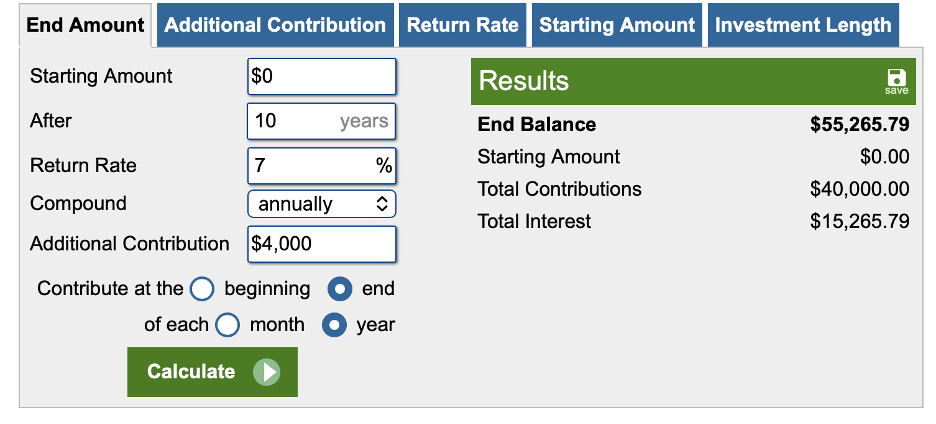
Over ten years, that hesitation could easily cost you $40,000 or more in additional income. And if that money had been invested along the way, the true cost would be even higher. Using a simple investment calculator, if you gain an extra $4,000 each year in stipends and invest the total amount for ten years, you could be missing out, not on $40,000, but on $55,000.
You don't have to become demanding or entitled. You don't need to negotiate every decision. But you do need to become comfortable having professional conversations about the value you bring to your school. **If you're solving problems, serving students well, and taking on responsibilities beyond your job description, it's reasonable to ask whether those responsibilities should come with additional compensation.
My goal isn't simply to convince you to chase stipends. It's to encourage you to think differently about your teaching career. Most teachers see their salary as fixed, with only annual raises and grid changes to look forward to. But there are often opportunities hiding in plain sight. Schools have problems that need solving, programs that need leading, and students who need someone to step up. Many of those opportunities come with stipends. The teachers who recognize them—and think strategically about their careers—are often the ones who quietly earn tens of thousands of dollars more over time.
