The 30-Hour Teacher Workweek
How teachers can do less, focus on what matters, and make their work compound.
30 min read
ON THIS PAGE
> How Can I Keep Work From Taking Over?
I didn’t mean to get into running but during COVID lockdowns, my six-year-old was bouncing off the walls. Each day, he rode his bike around the block while I ran. Two years later, I was running ultramarathons—31 miles in the mountains.
When I began training for the first race, my brother-in-law coached me. “For a 31-mile race, the most you need to run at one time is 18 miles.”
I simply couldn’t believe him—18 was so far from 31. How could that possibly work? I decided one Saturday I was going to run 26 miles. That was so much closer to 31. The day after running 26 miles, I woke up and couldn’t walk. I stayed in bed for three days praying that my foot would get better in time for the race.
Overuse Injuries
I’ve run four ultramarathons in total and, through the training, I’ve learned that more is not better. At first, I assumed that getting better meant running more: more miles and more days. At first, I saw dramatic results, but eventually, the curve starts to flatten. Getting a little better requires disproportionately more effort and can lead to overuse injuries.
Overuse injuries in the body result from repeated stress, not single events. To avoid these injuries, the body doesn’t need more; it needs better. Quality over quantity.
Teaching has a similar problem. We tend to assume that a better teacher is the teacher who stays later, grades more thoroughly, gives more feedback, creates more resources, and is willing to help with one more thing.
But more is not always better. In fact, it often leads to overuse injuries, which in teaching, we call burnout. Burnout results from repeated stress, not single event incidents.
A 2023 report from the RAND organization found that public school teachers worked an average of 53 hours per week—about 15 hours more than their contracted workweek. The National Center for Education Statistics reported similar numbers for the 2020–21 school year, finding that private school teachers worked an average of 51.8 hours per week, about 11 hours more than contracted.
In other words, the typical teacher isn't working a 40-hour workweek. They're working 50+ hours a week.
And they're not particularly happy about it. RAND found that teachers were less satisfied than other workers with their pay, hours, and overall well-being.
Minimum Effective Dose and the 80/20 Rule
After learning that more isn’t better, I then learned about another idea called minimum effective dose. The goal is to find the minimum amount of training that produces the maximum result. This strategy avoids overuse injuries, maximizes recovery, and is time-efficient.
Imagine that 8 hours of training a week gets you 90% of the benefit you’re looking for. To get the remaining 10% benefit would require an additional 3 hours per week.
Are those additional three hours worth it?
In teaching, the first 3 hours you spend planning a unit might make an enormous difference. The next 2 hours might make it even better. But at some point, you're spending another hour changing a good lesson into only a slightly better lesson.
While the initial effort often generates lots of payoff, at some point, each additional payoff point becomes increasingly more expensive. The 80/20 rule also gets at this idea, saying that 20% of the effort gets 80% of the results. The last 20% of results often requires 80% of your effort.
There is a point where more work doesn't produce a better teacher. It just produces a more exhausted one.
I no longer ask, “How much work can I possibly do?” Instead, I ask, “What work is worth doing?”
Once we figure out what work is worth doing, maybe we don’t need 50 hours a week to do it. Maybe we only need 30.
Many of our contracts require us to be physically present for around 38 hours, but being at work isn't the same thing as actively working every minute you're there.
If students are working independently, you might pull out a good book and read for 20 minutes while you supervise them. You’re still doing your job. You’re monitoring students and available if they need you, but you’re not grading, planning, answering emails, or creating something for school.
Those 20 minutes don’t feel like work—and that’s the point.
Currently, I've managed to get my time at work down to about 35 hours a week. My goal isn't necessarily to get my presence at school down to 30 hours. It's to get my actual work down to 30 hours. And most weeks, I do.
1. What Actually Matters?
Find Your 20%
Getting to 30 hours isn't about becoming incredibly efficient at doing everything teachers are expected to do. It's about questioning whether we need to do everything in the first place.
Minimum effective dose and the 80/20 rule give us a useful way to start. If roughly 20% of our efforts produce 80% of our results, then teachers should ask, what are the few things I teach that produce most of the learning?
This question can be applied at every level: the entire class, an individual unit, a lesson, or even a specific skill.
In English, a teacher might ask, what grammar rules account for most student errors? A study of 21,000 student papers reveals the most common grammar errors that make up 91% of errors. A teacher could use that information to focus their grammar instruction on the ten grammar rules that will clear up most errors made in writing.
The same can be done across subjects. In biology, is memorizing vocabulary included in the 20% of essential knowledge and skills and if so, what set of terms is the most important? In history, does understanding major causes of wars make the cut? What causes matter most?
It’s fine to teach beyond this 20%. But we have to know our 20%.
The Five Verbs
Once we know what matters most, we can ask a second question: What do we want our students to actually do with that knowledge?
For a daily routine, teachers tend to ask, “What am I doing today?” We should be asking, “What are my students doing today?” What five actions are most important for students to practice in this subject?
Choosing a handful of verbs can help answer that question. Print them on paper and if your whiteboard is magnetic, put magnets on the back.
For an English classroom, the words can be Read, Write, Study, Share, Craft.
Read: Students read a free-read book, class text, or book-club book.
Write: Students do low-stakes writing, thinking on paper, imitation, or brainstorming.
Study: Students deliberately study something they don't yet know—grammar, a mentor text, narrative structure, an argument, or a particular writing technique.
Share: Students talk. They discuss literature, share ideas, or read their writing aloud.
Craft: Students slow down and deliberately compose and revise. This is where they work on beautiful sentences, organization, and polished writing.
These five verbs are a way to turn the 80/20 principle into a daily classroom framework. They give the teacher a simple way to plan, keep the focus on what students are actually doing, and ensure that daily activities reflect what matters most. Know what you want students doing, not just what you want to teach.
Here are some other verbs that could work across a variety of subjects: Listen, Discuss, Question, Analyze, Practice, Apply, Explain, Create.
When using five verbs to structure your day, you don’t have to confine yourself to these five words. However, if you’ve chosen your verbs carefully, you’ll find that most of what you want to do fits within them.
You don't have to use every word every day, but if one of your verbs has been sitting untouched for days, that's worth noticing. It might be a visual reminder that you've drifted from one of your core beliefs about what students should be doing and from what you say matters most.
Know Your Audience
Identifying the most important knowledge and skills in your subject area is crucial, but it must be coupled with knowing your audience. The 20% that matters most depends partly on who is sitting in front of you. A group of students who already understands basic vocabulary doesn't need weeks of vocabulary instruction. A class struggling with foundational skills may need much more. Geometry teachers in different settings might find differences based on the particular students they are serving.
Knowing our audience doesn't just affect what we teach. It affects how we teach, how much support we provide, and where we spend our time.
Don’t blindly adopt policies you read about in a book or heard from another teacher. Consider your audience. While one school may accept late work forever, maybe you shouldn’t accept late work at all.
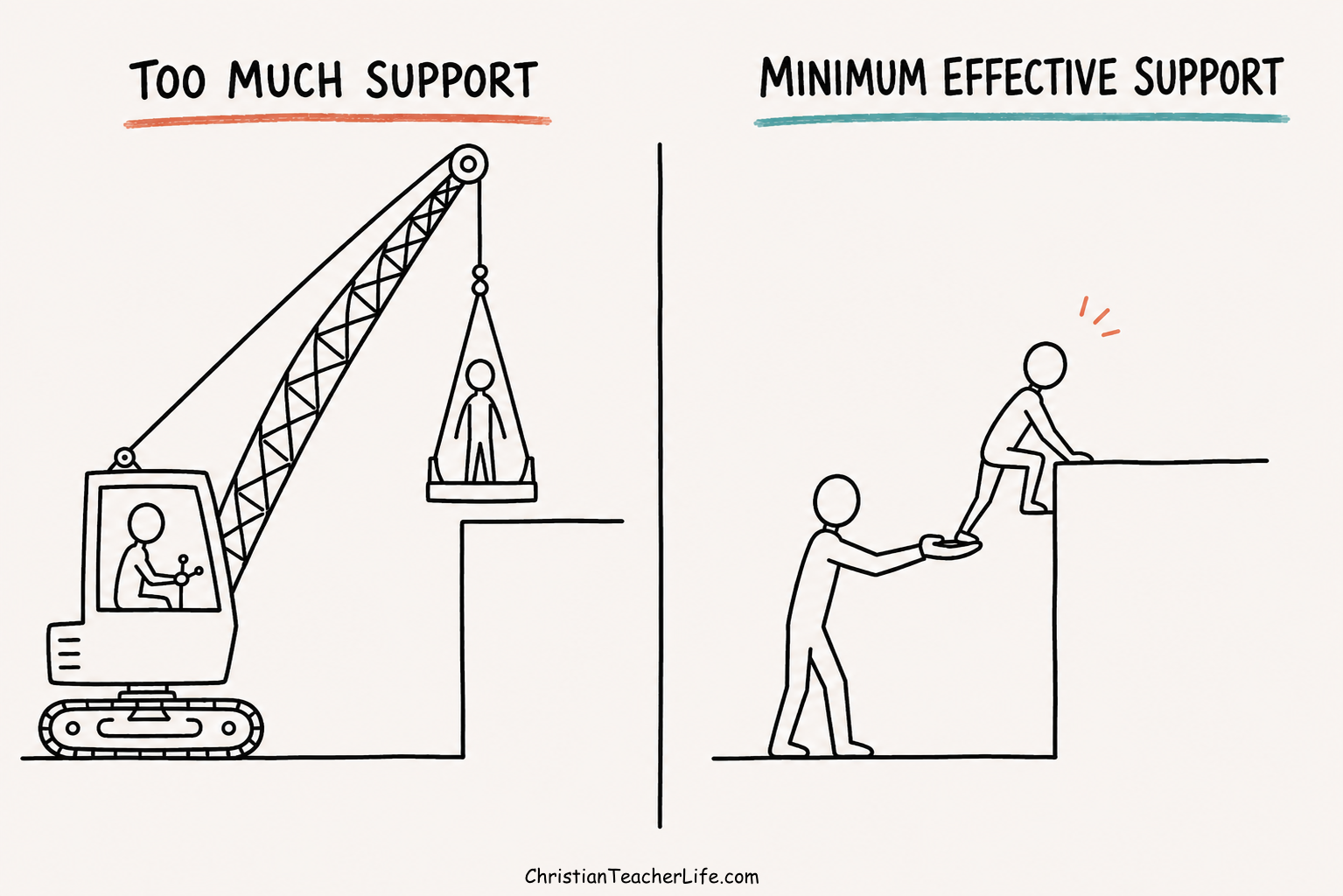
Our goal shouldn't be to provide students with as much support as possible. It should be to provide the minimum effective support they need to succeed.
That requires knowing our students. What can they already do independently? Where do they genuinely need us? What can they figure out themselves? What support actually changes the outcome?
If we provide more support than students need, we can accidentally make them more dependent on us rather than more capable without us.
Experiment and find out the minimal effective support your particular population can handle. Too many teachers are too helpful and it costs them a lot of time. Being less helpful saves you time and builds responsibility and ownership in your students.
But the same question we ask about helping students can be asked about our work: Do I need to do this at all?
2. What Can I Stop Doing?
Savior Complex
The serpent tempted Adam and Eve, telling them they could be like God. We still struggle with wanting to be like God.
Colossians 3:23 says, “Whatever you do, work at it with all your heart, as working for the Lord, not for human masters.” Christians tend to misapply this verse to mean we must give 100% every single time we do anything. Teachers might apply this verse to mean we must help every single student who needs it and do every task with 100% effort. But this is not what the verse is saying.
Jesus healed many people, but he also passed by a lot too and didn’t heal them. Why? Jesus said He only did what He saw His Father doing (John 5:19-20). He was governed by His Father, not by the needs and demands of the people around Him. Just because He could heal someone didn’t mean He automatically did.
To work for the Lord and not for man means we are constantly in prayer asking, “What would you have me do today, Lord? Direct my steps. Let me reach out where you reach out, and not reach out where you aren’t reaching out.” Let God be God and let us follow Him.
Sometimes burnout is God’s way of helping us realize we can’t do everything. We aren’t Him. Just because we can doesn’t mean we should. We have to say no to some things and other things will receive less than 100% effort. That is okay. We can still please Him.
If we can’t do everything, then we need to find work to eliminate.
After identifying the essential 20% for your subject and considering your students, the next step isn't to figure out how to do everything more efficiently. It's to figure out what you can stop doing. Marie Kondo, tidying-up expert, famously teaches people to get rid of things before organizing what's left. Don't organize unnecessary work. Eliminate it. Reduce it.
Reduce Communication
Email is necessary, but very often takes too much time. When dealing with email, consider whether it reduces time or extends time. I routinely have a lot of parent conferences based on my subject and grade level. One year, I sent a few well-crafted emails and it cut my conference time by 8 hours. Email can be time-saving, but not always.
Instead of exchanging five emails with another person before arriving on a date and time to meet, suggest three dates and times in the very first email. Once a date and time are decided, you do not need to send another email.
Some emails from your school are extremely long. Consider asking three colleagues what the email was about instead of reading it. Afraid to do that? Experiment. Ask three colleagues and then read it and see how accurate they are. Oftentimes, a summary from a colleague will suffice.
You don’t have to answer every email. For most student emails, don’t answer them. Simply talk to the student in class the next day. It’s much quicker.
Sometimes it is worth answering a student. I do occasionally check my email in the evening on my phone and only respond if it’s a very simple answer. Sometimes students have alerted me to an online assignment that isn’t working and I’ll go fix it, saving myself a million emails and a headache the next day. But most emails from students I leave unanswered and simply follow up in person.
If I do reply, most replies simply say, “Check the online learning management system.” By being “unhelpful” in this manner, it teaches students to use the tools they have and not rely on the teacher. Over the long term, it reduces the number of emails you receive from students.
If you open your email in the morning and see 35 emails from students, read two. If they say the same thing like, “The online assignment wasn’t working!” you can safely delete the rest of the emails without opening them. Scan the subject lines if you’re worried. Say to each class, “I know there was an issue with the assignment. I deleted all emails this morning. Raise your hand if your email was about something different and I’ll come talk to you.”
Creating a rule in your head that says every email warrants a response creates more work for you and is unnecessary. The goal isn't to respond to every message. The goal is to communicate effectively with the least amount of work necessary.
Provide Minimum Effective Support
Likewise, an internal rule that says you must help every student is not always helpful for you or the student.
If a group of students always shows up in your room after school asking for help, leave before they get there and lock your door. Do this for a week and it will break their habit. The goal isn't to abandon students who genuinely need help. It's to stop assuming that every student who wants your help actually needs your help. They will find the answers to their questions elsewhere and realize they don’t need you after all. That’s a win for everyone involved.
Your job isn't to make things easy for students. Your job is to help them become capable of doing things themselves and that often requires you doing less for them.
Stop Polishing Low-Impact Work
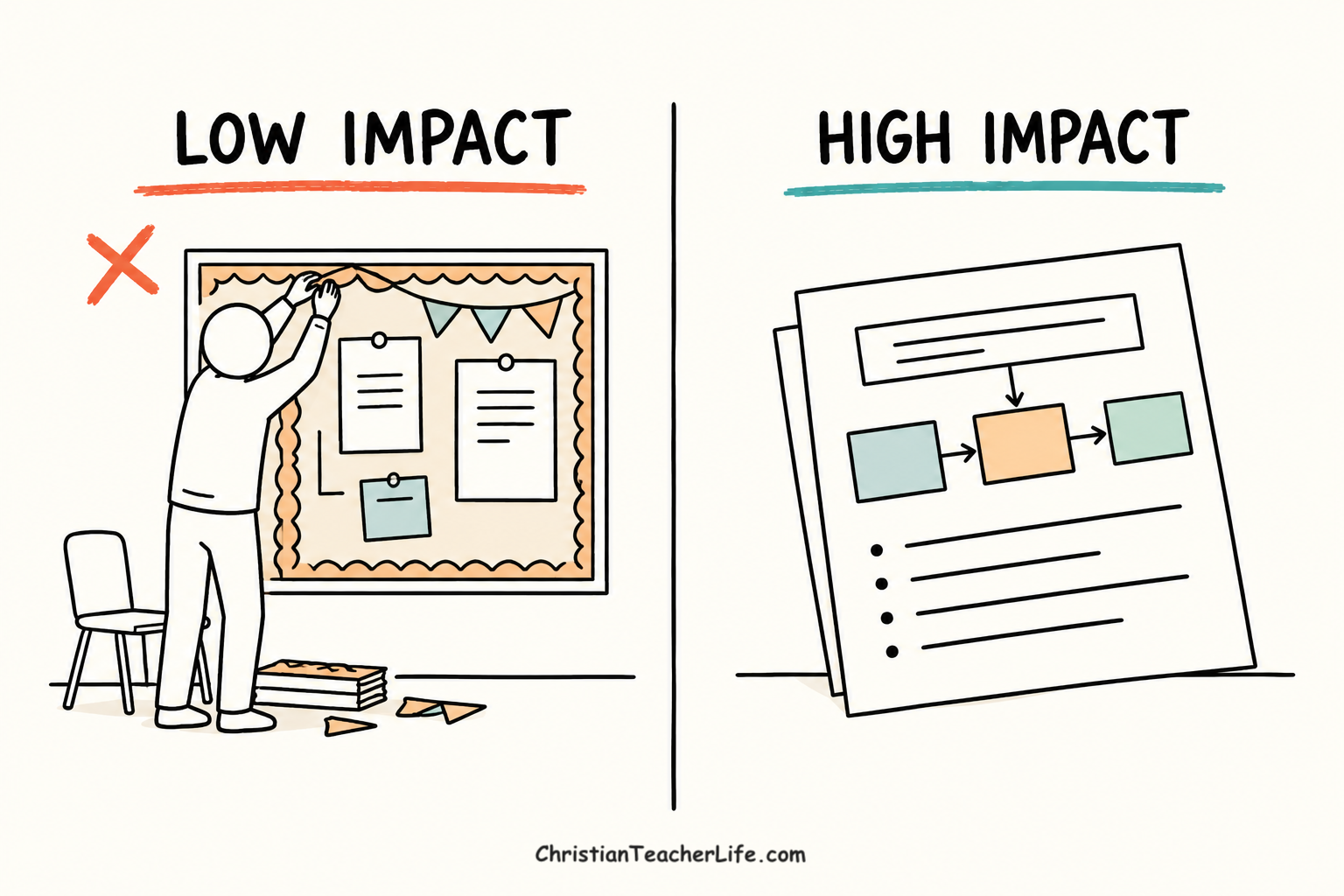
Teachers also spend enormous amounts of time on things they pride themselves on—and sometimes compete with one another over—that have little effect on student learning.
If you have time to make your class look nice, do it, but if you don’t have time, then this is unnecessary. It should be last on your priorities. Same goes for fancy worksheets and fancy slides. A black background with well-chosen text and images is all that’s needed and that can be done in minutes.
Match Effort to Value
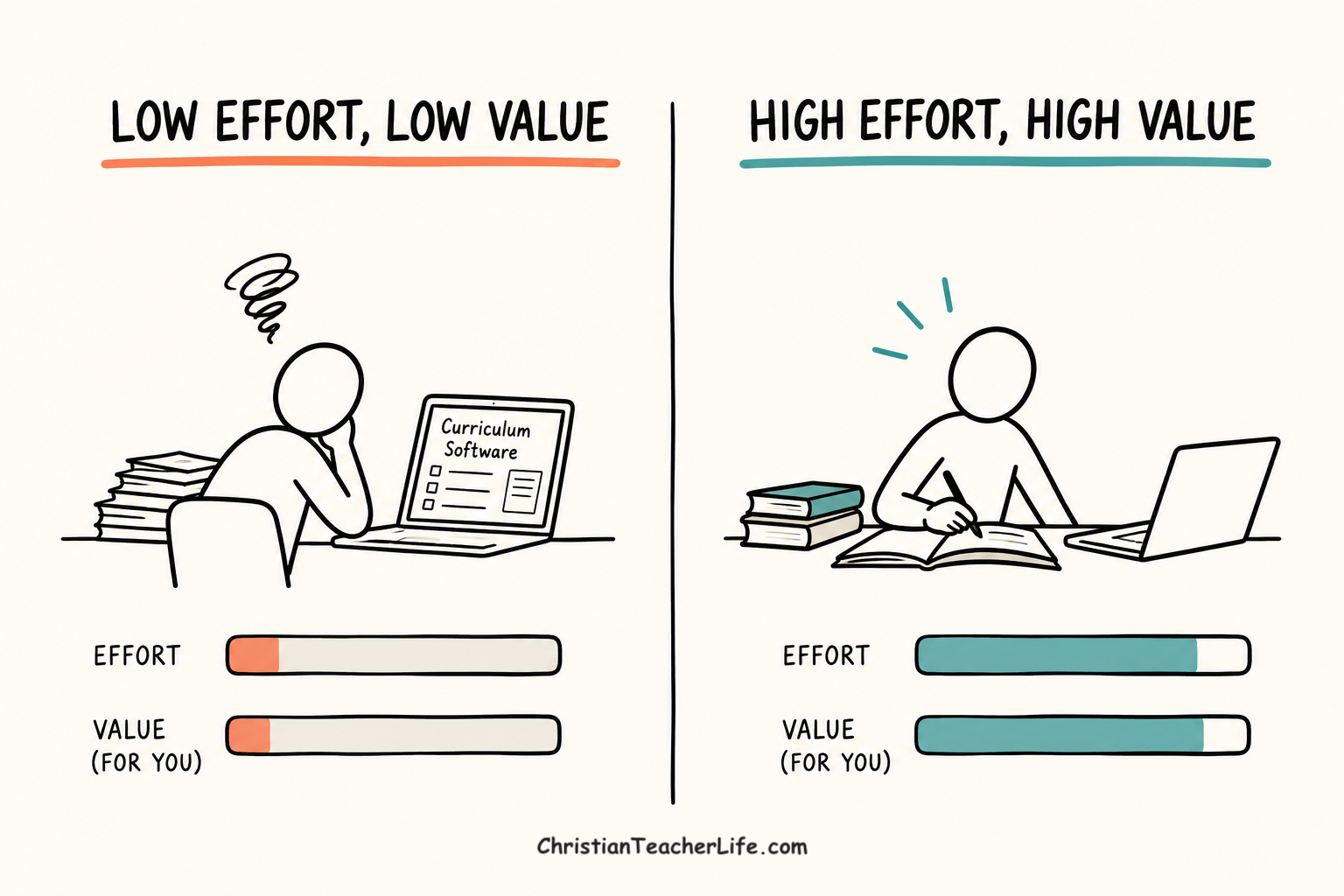
We need to not only discern where we waste time on low impact tasks, but where others are asking us to waste time. Not every audience deserves the same level of effort. Don't confuse being asked to do something with being asked to do it well.
Schools generate a lot of work for teachers that exists primarily for documentation, accountability, or organizational convenience. You should think carefully about how much time you invest in it.
Take curriculum mapping software. Your administrator may ask you to enter your entire curriculum into a program. There may be a legitimate reason the school wants that information, but ask yourself, will this actually improve my teaching? Do what is required, make it accurate, and move on.
The same principle applies to the small things: another spreadsheet, another form, another documentation requirement, another request to format something a certain way. Some of these things matter. Some don't. Your job is not to give every task the same amount of effort simply because someone asked you to do it.
Match your effort to the value of the outcome.
Read the room. I once was going to teach a summer camp. After talking with several administrators, I realized that my vision for this camp was way above what they were thinking. They just wanted a pretty good camp. That was disappointing at first because I wanted the best camp ever, but it relieved the pressure. I put on a pretty good camp, and kids and parents loved it. Administrators complimented me on it. I realized that their excellent was my good enough.
Good Enough
If you can get 80% of the result you’re looking for, that may be good enough. It might take too much effort to get that other 20%. Your efforts might best be directed elsewhere.
When it comes to your teaching, give yourself a break. The goal is long term growth. Make a change here and there this year but don’t kill yourself. Too many of us teachers are governed by perfectionism and control. We aren’t God. We are finite, fallen human beings. We can’t do everything perfect this year. Make some improvements so it’s a little better and be okay with good enough. Not everything has to be done this year. We have a lifetime to get this right.
3. What Can I Make Easier?
Once you've eliminated what you can, don't simply become more efficient at the work that's left. The goal isn't to become faster at everything. It's to build systems that make important work take less effort.
Know When to Invest
Making work easier doesn't always mean doing less work today. Sometimes you need to invest more effort upfront so that the work becomes easier in the future. The key is knowing which work will keep paying you back.
Some work compounds and some work disappears. Compounding work keeps working for you after you've done it. A good lesson plan, useful notes, or a repeatable routine can benefit you for years. Invest heavily in this kind of work and minimize the work that disappears.
When it comes to lesson plans, invest heavily in good lessons because they will benefit you now and in the future. If your plans are only on a school hard drive, get them to a hard drive at your house. Lesson plans are worth investing in and protecting. Do not reply on your school to secure these.
Be cautious about investing heavily in new technology, whether it comes from your school or online. PowerPoint and Google Forms are likely to be around for years, but that new tech the school just purchased? Skip it. It makes you reliant on the school’s budget or tech whims and that’s dangerous. Trying new tech is fine but be careful about investing too much in tech you don’t control. Too many programs and apps have disappeared.
Grade What Matters
Grading is necessary and provides you with beneficial information, but it is disappearing work. You will have to do it again next year. Therefore, be smart about it. Before trying to grade faster, redesign the system so that your time goes toward the assignments that matter most.
Make a spreadsheet for each class you teach (class, not section). Make a table for semester one and semester two. If you use grading categories, put those in with their percentages. Then, fill in every graded assignment under each category for the whole year. Plug in the point values and write the equations so you can see how much each assignment is worth of their overall grade. Don’t know how to do this? See the Grading Audit here.
After seeing how much each assignment is worth of a student’s overall grade, ask, does your grading and the weight given to each assignment match what you believe is most important? Does it match what is essential to your class? Does it match the time you devote to grading it?
Doing this exercise should be eye-opening. You might discover that a meaningless 10 point assignment is actually, because of the grading category and number of assignments, worth 8% of a student’s overall grade. Or you might discover that you spend 5 minutes on each of 80 assignments that are only worth .2% of a student’s overall grade. Points alone don’t tell the whole story.
Assignment weight should match your priorities, and your grading time should match the assignment's importance.
Once you’ve determined the few assignments that really matter, grade those well. But the rest? Grade them fast. Base them on completion. If there are 10 questions, give points for completion and choose to grade one question for correctness. Don’t spend lots of time grading assignments that don’t matter much. In fact, find a few assignments to stop grading all together. Collect them, and toss them. Focus on what actually matters. Students should have lots of practice which means not everything needs to be graded or graded strictly.
Build Patterns
Developing patterns now will pay dividends in the future. Choosing five verbs, as discussed earlier, can help you focus on what truly matters but it also provides a framework for planning every class period.
An English teacher might choose Read, Write, Study, Share, and Craft. In this example, the teacher has multiple options under the word Study. There’s a variety of things they could study and a variety of ways in which they could study–quietly marking up a text, in groups traveling around the room, grammar worksheets as a whole class. There can still be variety and novelty, but the five verbs provide a loose structure that reduces the need for reinventing every single class period.
Other patterns could be how you do a certain part of your class like how you study science terms or what lab day looks like. Pattens can also be how your online classroom looks and where assignments are posted.
Some may feel that patterns become predictable and therefore boring to students, but remind yourself that you may teach the same thing three times a day, year after year, but your students experience it only once. As the Study example shows, there can be novelty within a pattern and you can break from a given pattern at times. But patterns relieve us from making the same decisions every day. They reduce mental load for teachers, reduce questions from students, speed up transitions between activities, and increase learning time. Patterns also help absent students. When they return, they already know how the class works, where to find things, and what a typical assignment looks like.
Patterns give a class a recognizable rhythm. The specific lesson can change from day to day, but students know the kinds of things they will regularly be asked to do. That consistency provides a sense of stability and comfort over the long term and it makes teaching easier.
Be Organized But Not Crazy
If you spend two hours planning a history unit, every student who takes that class benefits from those two hours of work. If you spend two hours grading history essays, however, that time is divided among your students. Each student receives only a small portion of that investment through the feedback you give them. In other words, grading has to be done, but it often provides a relatively small return on the time it requires compared to lesson planning.
If you spend two hours making something valuable, don't let poor organization force you to spend another two hours making it again next year. Good organization protects the time you've already invested. If we don't stay organized, we can lose our notes, handouts, and plans and end up reinventing the same lesson the following year.
For paper handouts and files, keep a filing cabinet. Get lots of folders and a cheap label maker. Label each folder and throw handouts in the right folder. Keep the folders alphabetized. The goal isn't to create a beautiful filing system. The goal is to be able to find something when you need it. When it’s time to teach The Great Gatsby, pull out the Gatsby folder and take a look at what you have. It’s not necessary that everything within the folder be organized in any particular manner. Keep like documents together with a paperclip.
For digital files, do a similar thing. Keep folders for broad units, but it’s not necessary to have a million folders within that folder. The main way you should search digital documents is through a search feature, not through clicking through documents. On a Mac, press command and space bar. A search field will pop up. You can type in “Great Gatsby” and be brought instantly to your main folder, but also your Great Gatsby PowerPoint, vocabulary, close reads, or whatever else. This is much faster than searching through folders.
The same principle applies to digital files in Google Drive. Keep broad folders for your major units, but don't create a maze of subfolders. Search is often faster than navigation. The important thing is to give files names you'll actually remember. You don't need 47 perfectly labeled folders if Google can find “Animal ID Chart” in three seconds.
The point of organization is to find things quickly, not to organize things beautifully.
Lesson plans can be chicken scratch as long as next year, we understand what to do. PowerPoint can be awesome to keep lesson plans. If you're teaching Cell Biology, create a PowerPoint called Cell Biology. As you find useful videos, diagrams, questions, or activities, add them to the presentation. Don't worry about perfectly organizing everything immediately. Drop new resources at the end and organize them later if necessary. Your lesson plan might simply say “Cell Biology PowerPoint.” Open the PowerPoint, and the sequence of lessons—and all the resources you've collected for them—is right there.
Be organized enough to find things, but not so organized that organizing becomes work.
Keep Good Notes
Good notes preserve this year’s experience for your future self. If I learn a lesson in first period and remember it for second period, that’s a win. But if I write it down so I remember it for second period, next year, and every year after that, I’ve turned one experience into something that keeps paying me back. That’s compounding knowledge. You don't have to relearn the same lessons every year.
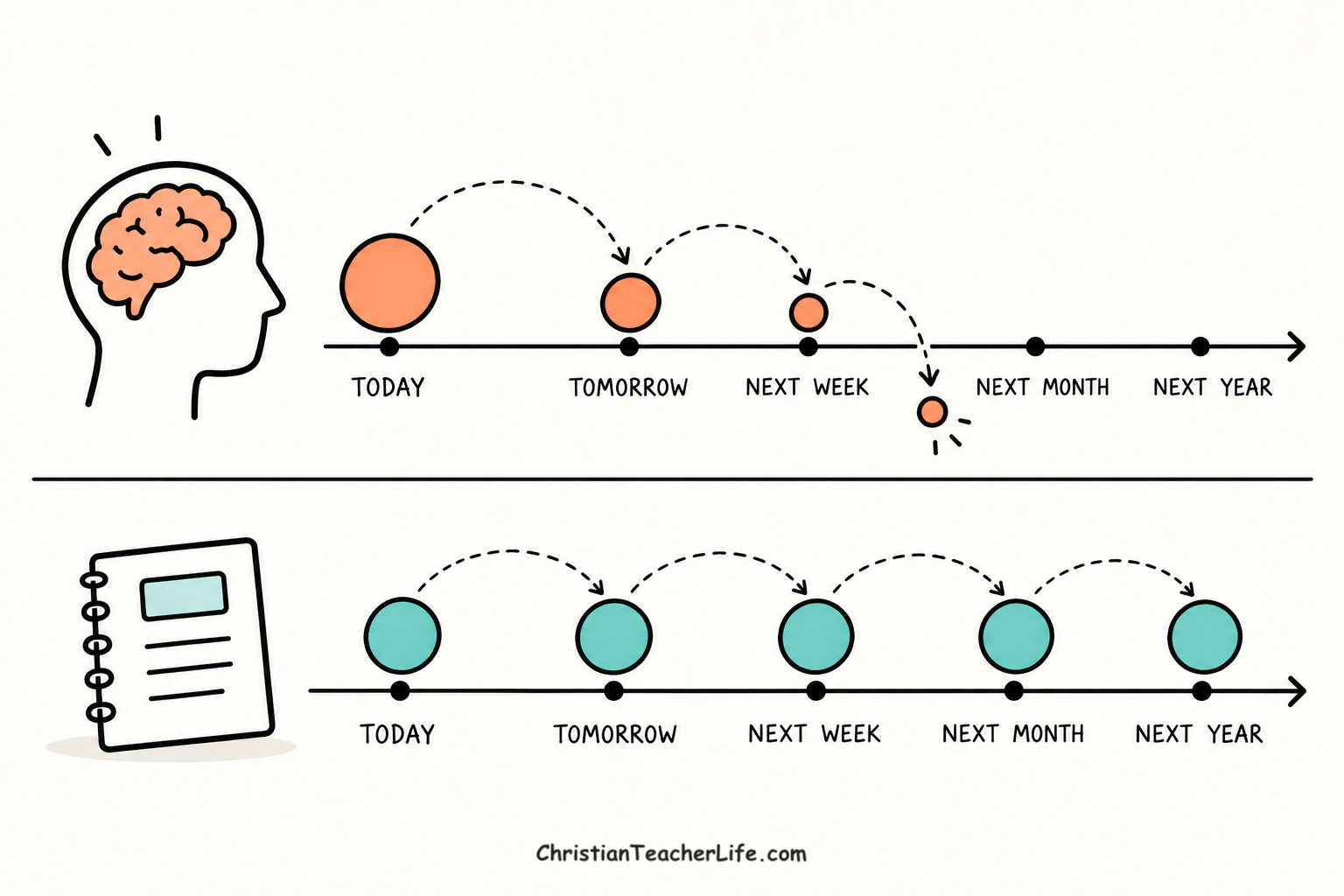
Good notes can be about pacing, timing, engagement, lesson improvement, implementation, grading or simply ideas. Ideally, notes are directive, but they can also be descriptive. Sometimes you don't know how to improve a lesson in the moment. You just know it needs improvement. That's okay. Your future self may have a better idea. Here are few examples of the notes you might leave your future self:
too rushed, needed about 3 more class period
takes 25 minutes
need better intro activity to get students interested
they loved the discussion. 12 minutes too short
make sure to email teachers for lesson in hall next week
do all 6 questions = 14 pts. Grade #2, #3 for correctness, 3 points each. Answers here.
make a game like “which one doesn’t belong” but for good and bad hooks
You might also go through a term sheet and cross out 6 that are irrelevant so you know to skip them next year. Notice how bad these notes would look in a formal document. That's fine. They're not for anyone else. They're reminders to your future self. They should be quick and to the point. The important part is to get the knowledge down in a way your future self can understand.
Now that you have some idea of the content of these notes, it’s important you store them in a place you’ll see. I store mine in three places: my lesson plans, PowerPoints, and a Notes app on my phone.
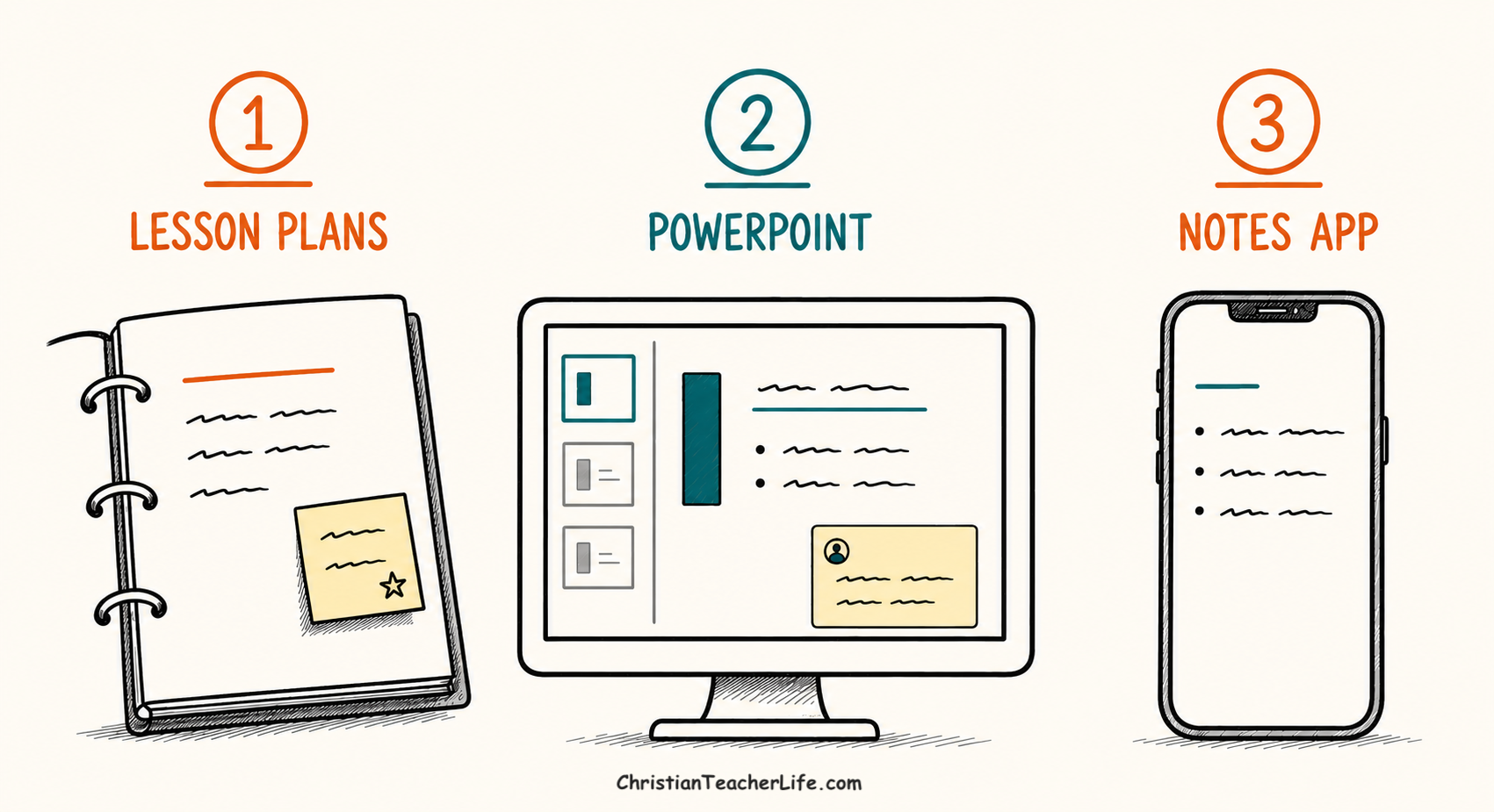
When lesson planning, whether you use digital and paper plans, it’s a good idea to have last year’s plans accessible. I switched to paper for this very reason. Since the calendar is slightly different every year, tiny adjustments need to be made. I write directly on the plans with parenthetical comments or I use sticky notes. Either way, next year I see what my plans were and I see my notes and can make adjustments. These tend to be about pacing, timing, implementation and tend to be minor changes.
More implementation notes are kept on my PowerPoint slides. When I open a PowerPoint, I see the sequence of questions, videos, prompts, activities, and my notes on how best to do each activity. I do not have notes on each activity. I can remember most of it. The notes are simply things I tend to forget or new improvements I want to implement. To be clear, my lesson plan notes tend to pertain to activities done in class, while my PowerPoint notes are directly tied to the material in the PowerPoint.
The final place I keep notes is in a note app on my phone. These tend to be big changes. The title of the document is called Notes For Next Year. I write the current year and simply make notes as I teach. I do this throughout the entire year so next year, the advice from my past self is in the same exact order I am teaching this year. I don’t separate them by class because my different classes progress through the year together. Examples might include the following:
First 6 weeks are fast for freshman-make sure they have time to draft in class
9th scene: make sure they draw out scenes before drafting
Look at point values for first three assignments-seems off
For sports essay, they want to use previous book. Let them.
Romeo and Juliet: letter to someone about their own relationship. Evaluate using Gottman before final essay.
The next year, I periodically scroll through the document as we move through the year. I’ll often see something we’re doing that week or something coming up, and it serves as a reminder. Sometimes I don’t make the change for various reasons, but many times I do. I put a check next to each note once I’ve implemented it.
I don’t delete previous years. The completed notes remind me what I changed and help me keep doing it. The unfinished notes sometimes bring back an idea I never implemented for whatever reason.
Keeping good notes turns this year’s experience into next year’s advantage. You're essentially leaving instructions for the teacher who will teach this course next year—and that teacher happens to be you.
Don't Do It Yourself
This section has focused on compounding work, work that keeps working for you, and making that easier. But not all work can compound. Writing emails, parent conferences, grading, and printing copies are a few examples of non-compounding work. Non-compounding work can be trivial, necessary, or important.
For the trivial, eliminate as much as possible. For necessary or important work that is non-compounding, first simplify it as much as possible and then delegate it.
Student TAs are one great source for delegating. After doing a grading inventory, you should be able to identify assignments that a TA can grade. If you leave good notes and give good instructions, a TA can grade quite a few assignments for you, especially completion based and practice-based assignments. It is worth spending a few minutes of your prep period getting materials ready for a TA. It may feel inefficient to spend five minutes of your prep period preparing work for a TA, but those five minutes can set them up for 60 minutes of work you don't have to do. Beyond grading, they can organize files, clean your room, decorate part of your room, track supplies, find materials for you and so on.
Try to get a responsible, capable student for a TA, and see how much they can do for you. Do you need major quotes for Hamlet? Have your TA type in “Hamlet important quotes pdf.” Have them find three different ones, print them, and read through them. They could give you their best judgement on the most comprehensive or they could highlight differences. The point is, TAs can do quite a lot for you if you find a good student and trust them. And in this Hamlet example, maybe they bomb it. Oh well. They didn’t waste your time. They just handed you three possibilities that you can quickly skim instead of starting the search from scratch.
Don't ask, “What can a TA do?” Ask, “What am I doing that doesn't require a teacher to do it?”
You can also look to outsource work. Delegation means having someone else do the work. Outsourcing means paying someone outside your organization to do it. I know, I didn’t think this was possible either for teachers.
I used to print multiple handouts for my classes but it took too much time. So I took all those handouts and made booklets. It saved me hours, but still took too much time, so I started having my TA make the booklets. Finally, I got my school to pay a printing company to do it all for me. What this means is that I spend five minutes uploading my material to a website, make a few clicks and the booklets are printed, bound, and delivered to my classroom. The school pays a couple hundred dollars and it saves me hours of time. It’s hard to estimate the exact time, but individually finding, copying, organizing, and distributing those documents probably took me about 12 hours per year. Switching to booklets reduced that to about 6 hours. Having a TA do most of the work cut it to about 3 hours. Now, outsourcing the printing and binding takes about 5 minutes of my time.
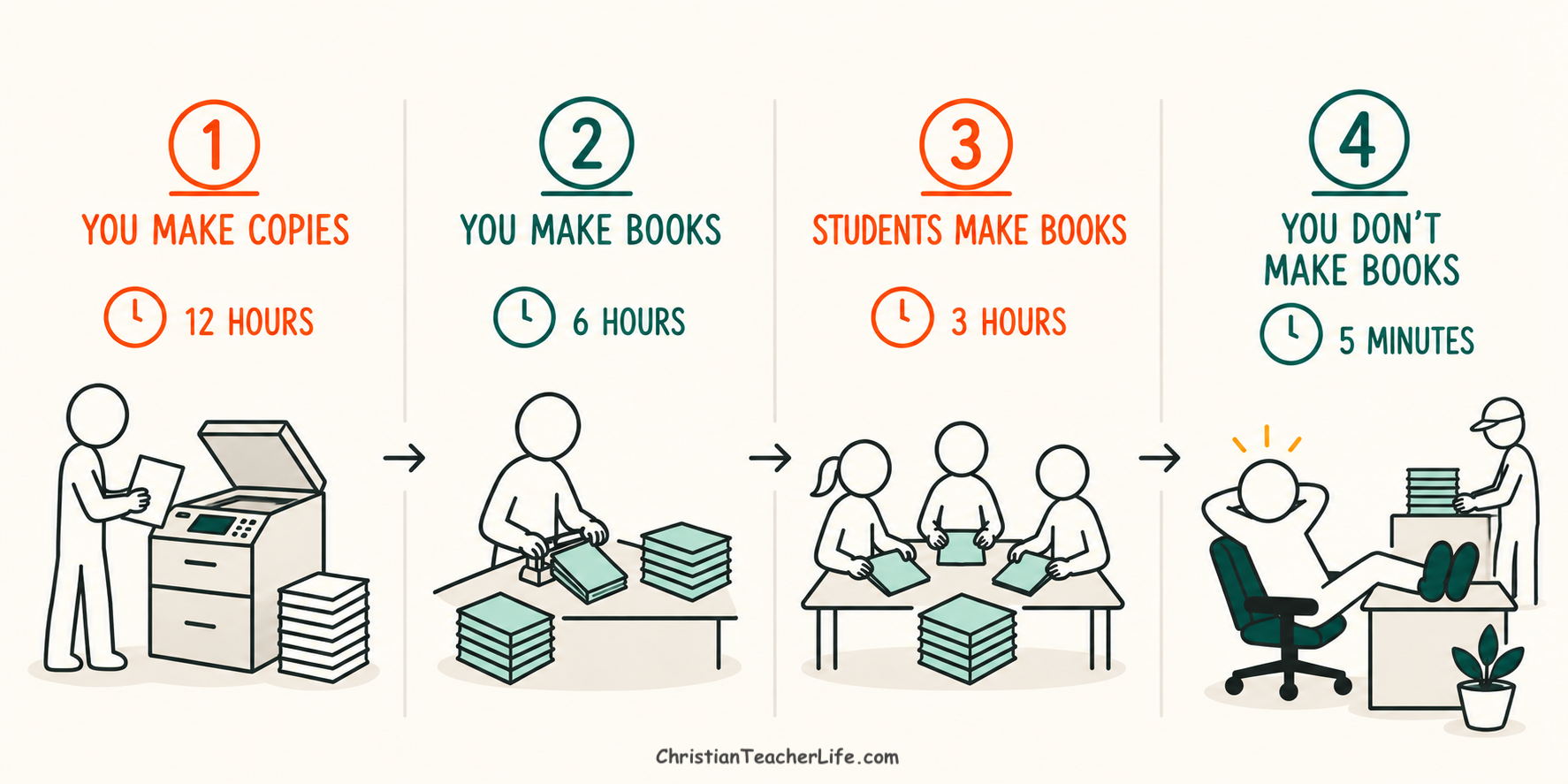
Notice: this time savings didn't come from becoming more efficient at the task. It came from progressively removing myself from the task. Outsourcing, though limited, can be a powerful tool when it turns a recurring task into something you barely have to think about.
4. How Can I Keep Work From Taking Over?
By now, you should know what matters most, have eliminated or reduced low-value work, and made important work easier to do. Now you need to contain the work.
Do It All In Class
Structure your class period so that there is independent work time. This is good for all subjects. Students need to do work in class where we can step in if needed, but aren’t directing the whole time. Handle things during this time instead of at lunch or after school. A student was missing and needs to make up a quiz? They can do it during this time. A student sent you an email. Don’t answer it. Talk to them now. A student had asked for help after school? Tell them you’ll handle it during independent work time the next day and make sure to follow up with them.
Handle work at work—not after hours, not at home.
Homeschool advocates often point out that students can get the same academic work done in half the time. They claim that schools waste time. I don’t know about that, but I do think they have a point. Is the school day 7 hours because it actually takes students that much time to complete their work or because parents need a place for their kids to go that’s longer than 4 hours? I think it’s a bit of both, so we should have time to handle everything in class. Rarely should things seep into lunch, before, or after school.
The goal isn't to work faster so we can fit more work into the day. It's to make the school day contain the work.
Set Boundaries
If we don’t set our own boundaries, someone will set them for us. I’m sure we all know that boundaries are good—for us, for kids, for relationships, and for dogs. But sometimes we feel bad or guilty for sticking with them. We have to get over this. Sit down and think about what you really want. Do you want to eat lunch with your colleagues? Do you want to eat alone and have some down time? Do you want to be tutoring kids at lunch and forget to eat? You have to decide and set a boundary and stick with it.
Create artificial boundaries. Maybe you can actually go home at 4:30 and it’s not that big of a deal, but set a boundary anyway and stick with it. It will force you to be creative, focused, and decisive. When grading, set a boundary. “This stack of papers will be graded today,” and then use every opportunity you have that day to finish.
Conclusion
The 30-hour week, as we’ve seen, isn’t about being more efficient at doing everything. It’s about focusing on what really matters and cutting as much as we can. It’s about knowing which tasks and people deserve our best effort and where good enough is enough. It’s about doing work that continues to work for us in the future and removing ourselves from the picture when possible.
If you implement these ideas, you may find that you have less work to do—and perhaps even a few extra hours at work each week. What should you do with those hours?
You could take on an extra responsibility for a stipend and use that time for the additional work. In that way, you can increase your income without increasing your hours at work. But you could also just read a good book.
Don't fill empty minutes with work simply because you have them. Sometimes the best thing you can do with an extra 20 minutes isn't more work. It's read a book.
Keep the Ideas in Front of You
I realize this article is long and wanted a way to put the framework, strategy, and ideas into a single sheet. I also wanted it to be visual so that as life gets crazy, teachers had a quick visual guide to remind them of the ideas in this article.
This is why I created The 30-Hour Teacher Workweek: Visual Toolkit.
It includes four printable visual guides that turn the ideas from this article into reminders you can keep at your desk, in your planning binder, or wherever you do your work.