Your Salary Isn't the Whole Story: Why Teachers Should Calculate Their Hourly Rate
Since my first year of teaching, I told myself, “The more you work, the less you get paid.” I reasoned that if my salary was fixed, then the more I worked, the less I got paid. Hourly, that is.
This mantra was not a way to justify laziness. It was a way to stop myself from overworking.
I noticed while student teaching and subbing that many teachers had a hard time turning work off. I was subbing at a Christian school when a teacher quite with three months left. I was asked to be a long-term sub for her and finish out the year. I shadowed her for a week to be introduced to her way of doing things. She made a comment the last day I was with her.
“I guess I can finally go back to church,” she said. Puzzled, I asked her why she hadn’t been to church. She replied, “Well, I haven’t been to church in years because I’m always grading on the weekend.”
I think I was supposed to be impressed at her dedication and work ethic, but I was not impressed.
The Teacher Workload Problem
A 2023 report from the RAND organization, a global policy think tank and research institute, found that public school teachers worked an average of 53 hours per week, 7 more than the average worker, and 15 more hours than their contract stipulated.
National Center for Educational Statistics, the main federal agency responsible for collecting and analyzing education data in the United States, reported similar findings for the 2020-21 year, two years prior to the RAND study. In addition, they also included private school teachers and found that private school teachers reported working an average of 51.8 hours per week, 11 more than contracted on average.
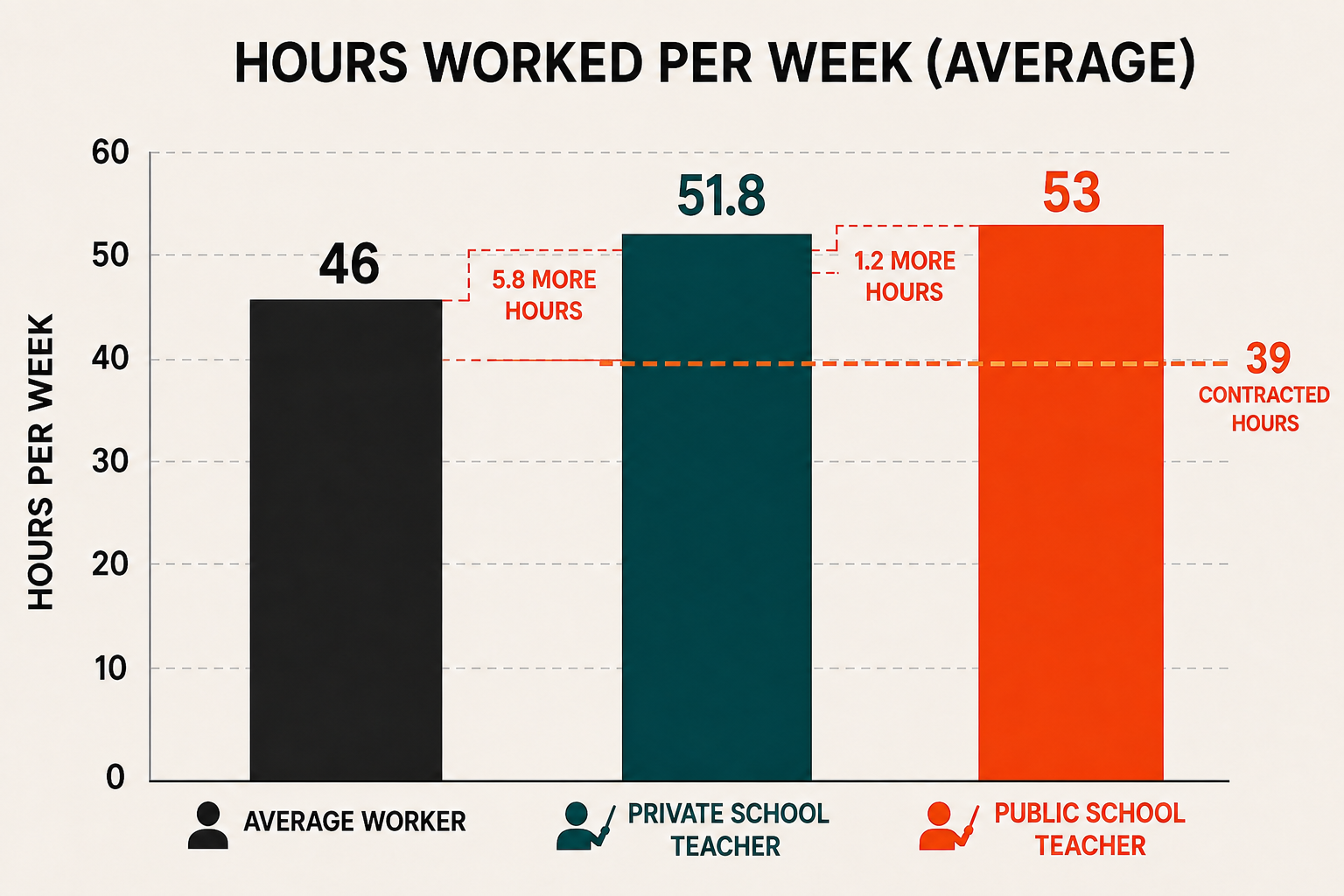
According to the RAND 2023 study, these public-school teachers were largely unhappy with their pay and the number of hours they worked. Public school teachers were satisfied less than other workers when it came to their salary, the numbers of hours worked, and their overall well-being.
The study also found that if teachers were considering leaving the teaching profession, pay and hours worked were often cited as the cause for their potential leaving.
Data on private Christian school teachers is much harder to find. I would assume that job satisfaction is higher based on my personal experience with coworkers, especially those who have left public education, but we should use this data as a cautionary tale.
Being unhappy with our salary and working too many hours are two working conditions that can burn teachers out and negatively affect well-being.
And, these two factors—pay and hours worked—are related.
I would argue that teachers aren't merely dissatisfied with how much they make. They're dissatisfied with the relationship between what they make and how much time the job consumes.
And this is where hourly rates can be more helpful than simply our salary number.
As private school teachers, we know that our salaries are usually lower, much lower, than public school teachers. If public school teachers are unhappy with their pay, then certainly private school teachers can also be susceptible to unhappiness as well. Likewise, private school teachers can also be susceptible to working more than their contracted hours require.
The conditions for private school teachers are obviously drastically different and the perks of private education such as smaller class sizes and supportive families do insulate the private Christian teacher some, but it does not make us immune to dissatisfaction with our pay or the numbers of hours worked.
The truth is that low pay feels worse when accompanied by excessive hours and a salary cannot be evaluated independently of the time required to earn it.
This is why teachers need another number besides their salary.
How to Calculate Your Teacher Hourly Rate
Your salary is the annual number of dollars you make, but it does not factor time into the equation.
On the other hand, your hourly rate puts that salary in relation to time.
There are a few things you need to know to calculate your hourly rate. You need to the number of days your school requires you to work. This includes the school year and any in-service days. This should be on some document or you can ask your HR department or principal. You also need to know what your contracted hours are per day. For example, your work may require you to work 183 days, and 7.5 hours per day. At $65,000 a year, your hourly rate would be $47.36.
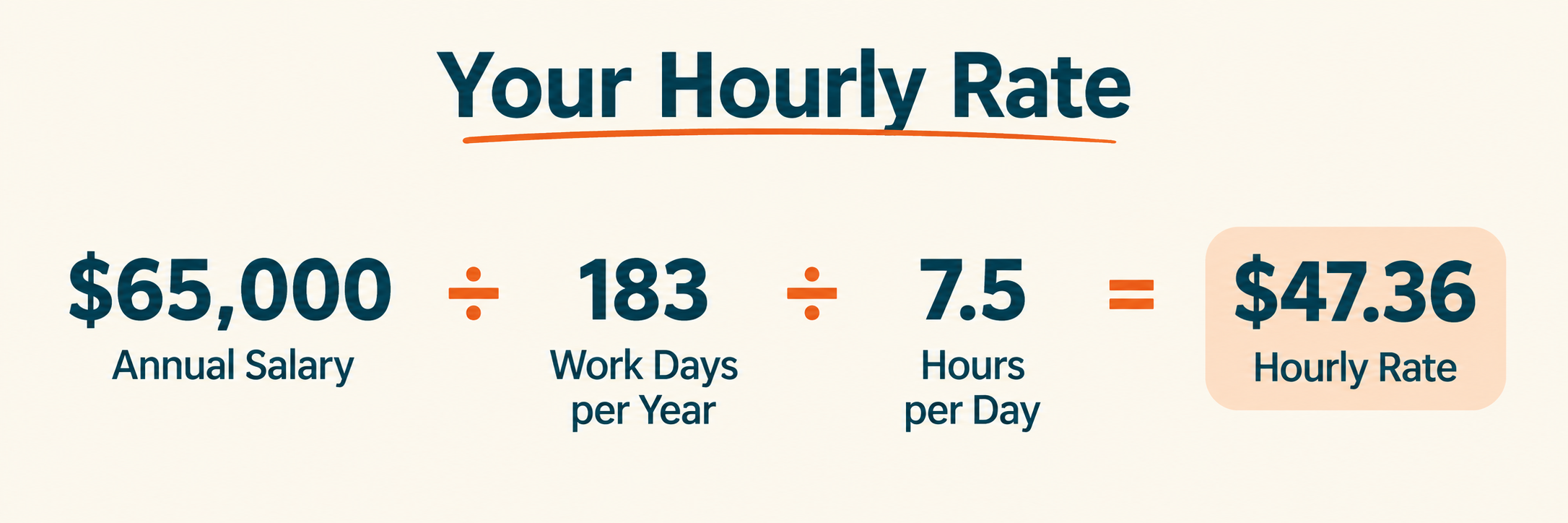
But it should be noted that this is your contracted hourly rate, not necessarily your actual hourly rate. We’ve seen from two studies that many teachers work well beyond their contracted hours, effectively decreasing their hourly rate.
The More You Work, the Less You Get Paid
There can be a difference, sometimes a huge difference, between your contracted hourly rate and your actual hourly rate.
Grading on Saturday or at night, answering emails at home, arriving very early or staying extra late, after-school meetings or lunch meetings, and extracurriculars can all take lots of extra time outside of one’s contracted hours and they each lower one’s hourly rate.
If that same teacher works another 10 hours every week outside the contract, or 2 more hours per day, their actual hourly rate is dramatically lower.
Working Hard Doesn't Mean Working All the Time
I'm not arguing that teachers should work less simply because work is unpleasant. I'm arguing that our time has value.
Good teaching does not necessarily mean working more than your neighbor. It doesn’t necessarily mean staying late or arriving very early. A good teacher could be the first to leave after school.
I’m also not saying that there aren’t times and seasons when you might choose to work more. Teachers in their first couple of years might work a bit more than a veteran teacher who has their lesson plans complete. A year when a new class is added might require a bit more work. There also might be special circumstances. There may be a committee that meets about an issue you really care about or a school dance you really want to chaperone.
However, even in these circumstances, it’s wise to set boundaries and to always remember what your time is costing you. Be conscious what your time is costing you.
The goal isn't minimum effort. The goal is a sustainable amount of effort.
How to Increase Your Teacher Hourly Rate Without a Raise
You can increase your hourly rate by increasing your overall salary, as long as it doesn’t affect your total hours too much. Your compensation needs to outpace your hours in this case. A couple of ways to do this is to increase responsibilities like being the department head or receiving a raise or by switching to a higher paying school. You can also use The Stipend Strategy.
Increasing your compensation is one lever we have to raise our hourly rate but the other lever we have is lowering the amount of time it takes to do our job. If you currently work 50 hours, you can increase your hourly wage by getting your work done in fewer hours, say 35 hours per week.
How do we decrease the amount of time we work? By doing a poor job? No. By creating better systems, thinking strategically, grading more efficiently, eliminating unnecessary and low-value work, and setting boundaries.
Now, some may say, “Who cares? My salary hasn’t increased at all through doing these mathematical gymnastics,” and that would be true. But remember what the study found: public school teachers weren’t happy with their salary and the number of hours worked. These are probably related.
I don’t know anyone who would be unhappy working 1 hour for $30,000. Yes, $30,000 is a low salary but if it takes you 1 hour to earn, I don’t of anyone who would complain. Likewise, $150,000 might sound nice but if it requires you to work 80 hours in very unpleasant conditions and commute three hours each day, it might not seem worth it.
In other words, of course salary matters. We have to live life and meet the needs of our family and this is why The Stipend Strategy is valuable in helping private school teachers increase their overall earnings. But salary isn’t the only thing that matters. The number of hours we work to get that salary matters a whole lot too. There are some salaries that simply aren’t worth it considering what it takes to get there. To accurately access our salary, it’s helpful to think in terms of our hourly wage and thinking in hourly wages may also increase our job satisfaction.
You don't necessarily have to increase your salary to increase your hourly rate. You don't have to get a $5,000 raise. If you can reduce the amount of time required to do the job, you've effectively increased what each hour of your labor is worth.
This is why I think teachers should stop thinking exclusively in terms of salary.
How to Compare Teaching Jobs Beyond Salary
When comparing jobs, whether both are private or one is public or both are public, we should consider more than the salary. We should look at the effective hourly rate as well.
Instead of asking, “Which school pays more?” we should also ask the following questions:
What is the salary?
How far is the commute?
How many days do I work?
How long is the workday?
How much work happens outside the contract?
How much grading is expected?
How many meetings?
What extracurricular expectations exist?
What responsibilities come with the position?
What benefits are included?
Asking these will get us much closer to the real hourly rate. I had a principal who once confided in me, “I don’t think I get paid any better per hour as a principal. I thought I would.” She was easily working 10-hour days and many of these hours were at night and on the weekends, which in my mind, are more valuable.
Sometimes, because of the stress of our job, we eat out more, we have more medical problems that cost money, and we are more distracted and irritable at home which takes a toll on our relationships. These are all hidden costs. Two jobs might differ by $10,000 but when the hourly rates are compared, they might not be all that different.
Should You Teach at a Public or Private School? Do the Math
Your hourly rate is also helpful is making the decision to go teach at a public school. Private school teachers can make a whole $30,000 less than their public-school counterparts, but overall salary does not tell the whole picture. Here, it is useful to actually look at your local district and not simply national averages or medians. Then, look at the numbers of days worked. Estimate a longer work day for public schools than you currently work to account for the extra responsibilities that public school teachers have that we private school teachers don’t have. This will get you closer to an hourly rate that you can compare.
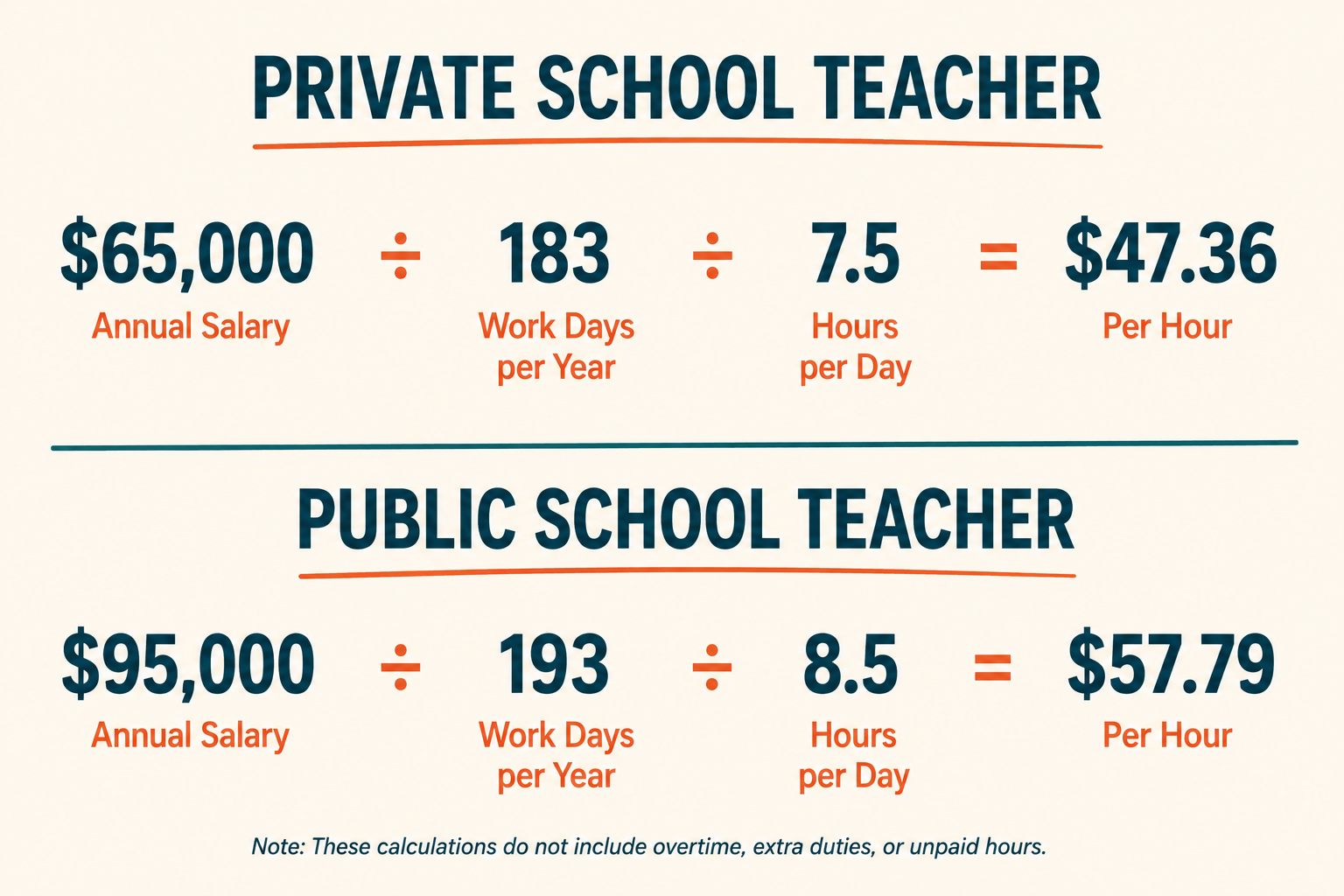
While looking at the salary is helpful, it is only one way to look at these numbers. In this example, there is a $10 an hour difference. Now I can try to pull on different levers to close that gap. What if I move that 7.5 hours of work per day down to 7? Now my hourly rate increases to closer to $51. That’s much closer.
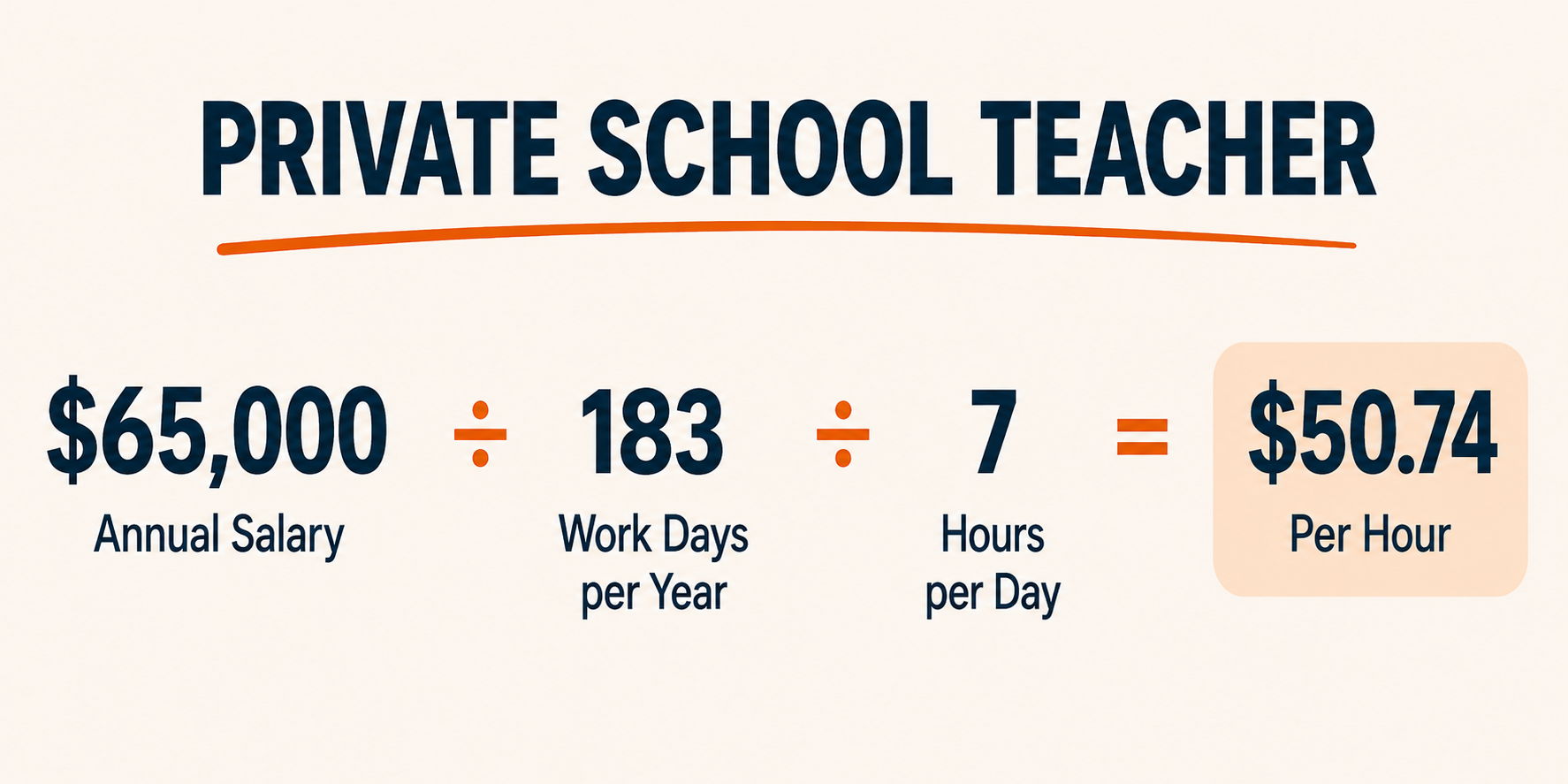
By doing this, we have effectively increased our pay per hour by reducing our number of hours worked. Remember what teachers were unsatisfied with? Low pay and high number of hours worked. We just increased our pay (per hour) and decreased the number of hours worked.
There are other considerations too. Maybe you have kids who attend your private school and you receive a tuition discount. This discount can be figured into your hourly rate. Maybe the public-school job is more stressful. You should try to put a number to this.
When I run this same calculation for a near-by public school, the salary difference is $30,000. However, I receive about $20,000 in tuition discount for my kids. If I did teach in a public school, I would still send my kids to a private school, so we are really talking about a $10,000 difference. But when I further run the numbers and calculate in commute, number of hours, and stress, the difference per hour is not that much.
Salary is important. It just isn't sufficient.
When you run your own numbers, perhaps the public-school job is still the better deal. If it is, you’ll know that the higher salary is worth the additional demands of the job. Or perhaps the difference is much smaller than the salaries initially suggest. You might even discover that the lower-paying job gives you a better hourly rate.
The point isn't to tell you which job to take. It's to give you a better way to compare them. Before you make a career decision based on salary alone, do the math. Look beyond the paycheck and consider what each job asks of your time.
Is that stipend worth it?
Once you begin thinking hourly, every additional responsibility looks different. If we are asked to join some committee for no additional pay, we should calculate those hours in and know that it decreases our hourly rate. This doesn’t mean we automatically say no. There are several good reasons we might say yes, but in the back of our mind, we should do the math and know that our hours are going up and our (hourly) pay is going down. If we don’t want to burn out in teaching like so many do, we need to be mindful of the direction of these two numbers.
While many meetings and committees don’t come with pay, there are other time commitments that do come with pay, namely stipends, but not all stipends are created equal. There might be a stipend for running National Honors Society, another for being the department head, and another for an after-school club. We should calculate the hourly rate of each, keeping in mind that those that can be done during the school day, do not really cost us any more hours worked. The hours worked during the day don’t matter nearly as much as those hours worked outside of our contracted day.
Let’s suppose you have a few possibilities.
Committee with no stipend
After-school club with $1,000 stipend
Department chair with $1,000 stipend
NHS with $1,000 stipend
Notice that 3 of the 4 appear equal if you look at salary, but they are not equal when you look at time. If the extra work can be done during class or during your prep period, then it’s not really costing you extra hours. But if the work is done at lunch, after school, or on the weekends, you need to add the hours and calculate your hourly rate. Four opportunities can offer the same $1,000 stipend and be four very different deals.
Three pay $1,000, and the committee might seem like a small obligation that doesn't affect your salary at all. But when you consider the additional time required, they look very different. The department chair stipend adds $1,000 without adding any hours outside the school day. The after-school club pays $100 for every additional hour, which is higher than your normal hourly rate. NHS pays only $33.33 per additional hour, lower than your normal hourly rate, while the unpaid committee work actually lowers your overall hourly rate. A $1,000 stipend can be a great deal or a terrible one depending on how many additional hours it requires.
The size of the stipend isn't the only thing that matters. When evaluating extra work, don't just ask how much it pays. Ask how many additional hours it will cost you. Ask, "How much does it pay for each additional hour?"
Your Time Is Part of Your Compensation
Thinking about hourly rates isn't something to obsess over, nor is it intended to turn every decision at work into a financial calculation. But especially at a private Christian school, we often don't talk openly about money or time—the two critical factors behind much of the teacher dissatisfaction discussed in the studies earlier.
Christian teaching is often described as a calling or even a ministry. And there can be some truth to that. But that language can sometimes make conversations about time and money uncomfortable. It can be easy for administrators to ask teachers to take on another responsibility, attend another event, or work another few hours without additional pay. It can also be easy for teachers to accept because we see our work as ministry and want to serve our students and our school well.
But teaching can be both ministry and a career, and time is required for both, and our time is precious. Calling something ministry doesn't make our time expendable.
Christian schools have an especially important responsibility to think carefully about how they use the time of their teachers. Teachers are called to serve their students, but they are also people with families, churches, communities, bodies that need rest, and lives outside of school. A commitment to ministry shouldn't require us to pretend those things don't matter.
Know Your Number
Time and money are hard to talk about and this is one reason I find the hourly-rate calculation useful. It gives us a way to talk about something that can otherwise be difficult to discuss. It doesn't tell us whether a responsibility is worth doing, but it does tell us what that responsibility is costing us in time.
Sometimes that cost is worth it. Sometimes it isn't. The important thing is that we know we're making the trade.
Knowing your hourly rate can help you evaluate whether a teaching job is worth taking, whether a move to a different school actually makes financial sense, whether an extra responsibility is worth the time it requires, and whether the work you're doing outside your contract is becoming excessive.
Salary still matters. A lot. We need enough income to support our families, save for the future, and live the lives we want to live. But salary is only one part of the equation.
I still think about the teacher who told me she hadn't been to church in years because she was always grading. I don't know what her salary was. I don't know what her hourly rate was. But I know that her job was costing her something that didn't appear on her paycheck: her time.
Your salary tells you how much your school pays you, but your hourly rate tells you what your time is worth.
Teachers should know both numbers.
Your salary is only part of the picture. This free calculator helps you calculate what your private-school teaching job actually pays per hour—including additional work, stipends, tuition benefits, and commuting. Enter your email below to get the calculator.