The Three Levers of Importance
Try this experiment. Ask your students to list five things they think you value most in your classroom and then read what they say.
Will their answers match your actual priorities?
This exercise is a good reminder that there can be a difference between what students think we value and what we actually value.
The 80/20 Rule suggests that a relatively small number of things account for most of our results. For teachers, this means identifying the content, skills, and habits that matter most for our subject.
But identifying your 20% is only the beginning. The next question is, how do I show my students that these things are important?
For most teachers, the answer is simple: points. If something is important, make it worth a lot of points.
But teachers can communicate that something is important in other ways too. Teachers have three primary levers to communicate importance: Points, Time, and Space. You might be thinking, “What about words? I tell my students all the time what is important in my classroom.” I haven’t forgotten them. What we say with our mouths is simply one way we can use the Time lever.
These levers can be used together or in isolation. Something can receive a lot of class time and very few points. Something else can be worth a lot of points but require very little teacher time. And something else can receive very little time or points but occupy a prominent place in the room.
The question isn’t whether teachers use these levers. We use them every day, and our students notice. The question is whether we’re using them intentionally and getting as much as we can out of each one. It’s one thing for us to know our priorities; it’s another for our students to know our priorities.
How the Levers Are Different
Before looking closely at each lever, it’s important to understand some of the differences. These are not three levers that do the exact same thing. If they were, it wouldn’t matter much which one we pulled.
They Have Different Tradeoffs
While all three levers are limited, Time’s limitations are the most felt. We inherently understand that ten minutes of class time on one thing means we can’t spend those same ten minutes on another.
But Points and Space are also limited. Points have to equal 100%, and our classroom walls are only so big. Doubling the amount of time you spend on something is very noticeable, but it’s easy to double what an assignment is worth without feeling anything. Yet every time we increase the points assigned to one thing, we dilute the weight of everything else in that category. Likewise, giving something a prominent place on our walls means that something else cannot occupy that space. It also changes the attention everything else receives.
All three levers are limited, and all three have tradeoffs. Be intentional about Points and Space, like you are with Time.
They Create Different Experiences
The three levers also create different experiences for students. Points can often feel a bit negative. Lots of points can communicate a “do this or else” mentality. Points can push students toward a behavior, providing extrinsic motivation, while Space in your classroom can pull them toward a behavior. Space naturally lends itself to celebration, encouragement, and intrinsic motivation. Time can do either. You might spend time on an important task that students more or less hate, or time could be spent on a task that most find very enjoyable. This is why some lessons feel like we’re pushing students through them, while in others, students get into it and run ahead.
It’s important to keep these feelings associated with each lever in mind because they can help you decide which lever to pull. An English teacher might want students to read. Is simple compliance the goal or do the feelings associated with reading matter? If compliance is the goal, make reading worth 30% of their grade. But if you want students to read and to like reading, it might make more sense to pull the lever of Time and Space, inviting students to become readers.
They Work Differently Over Time
The three levers also differ in how students experience their importance over time. Space is always around students, quietly communicating without requiring any additional intervention from the teacher. You set it up once, and it continues communicating day after day. However, it only works while the students are in the room.
Time requires more ongoing maintenance from the teacher. A teacher can set aside twenty minutes for reading one day, but must carve out twenty minutes for the next day, again and again. But Time has one advantage that Space does not: it can extend beyond the classroom. Every time students do work in study hall or at home, the Time lever continues to be used. The teacher doesn’t have to be present for Time to work.
Points are different still. Points are easy for teachers to allocate, but they can be costly for students. They can have a large, immediate impact when attached to a single assignment, but their impact can also accumulate slowly. Ten percent of a grade can feel significant when it comes from one assignment and surprisingly small when it is spread across ten assignments. The total percentage is the same, but students may experience its importance very differently.
The point is that the levers are different. When deciding which lever to pull, it’s worth considering not only whether it will get students to do what you want, but also how it might shape their experience while doing it.
Now let’s look at each one.
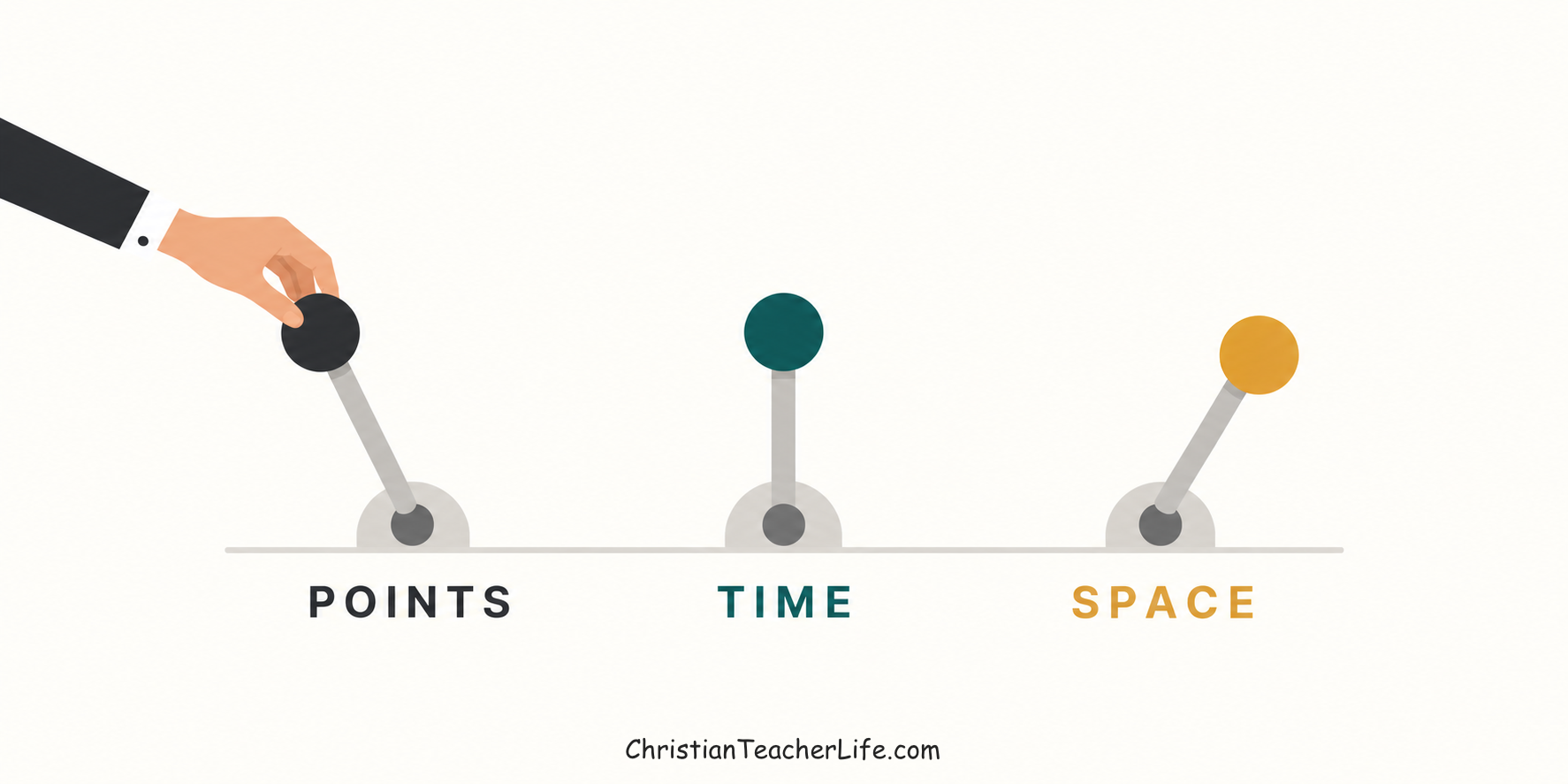
Points
This is probably the most obvious lever. We know that if we want students to take something seriously, we can attach a lot of points to it. If a student doesn’t do it, it will cost them heavily.
However, if every assignment receives a lot of points, it dilutes the overall value of each assignment. Some teachers have never conducted a grading audit and therefore think that their 100-point assignment is worth a lot. But because of grading categories, that assignment could be less than another 20-point assignment in another category. It’s important to conduct a grading audit to make sure we are using our limited points wisely.
While there is no inherent relationship between Points and Space, there is a natural relationship between Points and Time. If you want students to spend lots of time working on something, you may attach a lot of points to it, even if you intend to spend very little time grading or teaching it. A student reflection is one example. You will not spend much time grading it, but you want students to spend real time reflecting so you attach a lot of points to it.
On the other hand, if something is worth a lot of points, you might need to spend more time grading it or teaching it. Points can influence how much time students spend on an assignment, but they can also influence how much time teachers spend on it.
Points, while effective, do have their limits. What if the assignment or skill is very important but easy to cheat on no matter how many safeguards you put in place? What if something is important to you but it’s difficult to grade? What if you want students to make a life change out of intrinsic motivation and not compliance? These are all cases where points can fail you. You need a different lever.
Time
Time is our most expensive lever. Every minute spent on one thing is a minute you can't spend on something else. What we spend time on shows what we care about. Time can show up in several ways: what you spend class time on, what you ask students to spend time on, and what you spend time grading or developing.
We usually pair Time with Points, as mentioned above, but they don’t need to be joined. You could spend a lot of time on something and attach very little points to it. Research, reading, math practice, and a history discussion might take up time and be worth very few points.
I taught health for several years and wanted students to live healthier lives as a result of the class. One goal I had was for students to give up sugary drinks. We spent time watching documentaries on sugar and made posters with soft drinks and sugar cubes. Many students did give up sugary drinks but they received zero points for that decision. I wanted that decision to be entirely their own and not out of compliance for points. Lots of time was spent getting students to this decision, but zero points were given once there. The two do not have to be joined.
Besides content and skills, the time you spend on something could communicate how much you value student voices, what teaching style you think is most effective, how important experimentation is, and how okay it is to be wrong. It’s worth reflecting on what you think is important in each of these domains.
Space
If a teacher has their own classroom, they must decide how to use their physical space. What we choose to put in our classrooms and on our classroom walls communicates our priorities. A teacher could have a vast library, or display student work, or put up posters about a growth mindset. A growth mindset might be very important to a math teacher, but assignments and points may not be the best way to communicate its importance.
A Bible teacher might want to communicate that knowing God is relational and therefore have couches in their room and mood lighting. Or they might want to communicate that studying the Bible deserves the same rigor as any other subject and create their space to communicate that instead. The idea that physical space communicates importance isn't new. Cathedrals were often designed to invoke a sense of awe for God. Likewise, what does our classroom say about our subject and our priorities?
How much of your classroom is for you, the teacher, and how much is for your students? That too communicates priorities.
Space does have some limitations. Some things are simply easier or more visually appealing to display than others. A book cover is easier to display than a page of writing. Growth mindset charts might be easier to display than geometry proofs. This is another reason to use all three levers.
How I Use the Three Levers
Here’s a few ways I’ve used these levers through the years.
Reading
Students read at least nine books a year in my class, with some reading as many as 80. In terms of points, this accounts for 10% of their overall grade, relatively low in my estimation. While I can monitor their reading in class and have a couple other safeguards in place, I recognize cheating can occur. If a student reads 70% of the book and calls that “completed,” they will only receive maybe a 3% grade bump without doing any work. Pretty low in my estimation, especially considering that most kids will not cheat. But the risk of cheating still exists, so I limit Points.
However, reading takes up most of the space in my classroom. A large library occupies a wall, there’s a wall display of books that I’ve read, a race track shows how many pages per week students are reading, and photos of past students holding the books they’ve read decorate one wall.
For Time, 30% of our class time is focused on reading. Looking around and seeing every student with a different book builds a reading culture. Plus, I don’t trust that kids will always read at home so I use the time that I do control.
I choose to primarily pull the lever of Space and Time when it comes to reading. These levers are fun and encourage intrinsic motivation. I minimize the Point lever because I don’t want to reward cheating if it occurs, and I want more than compliance. I want students to become readers.
Primary levers: Space + Time
Writing
I have a few posters related to writing but very little. They are a few motivational quotes about writing that I do reference and are meant to encourage students, but overall, I devote very little Space to writing. Overall, writing doesn’t make for great classroom décor.
However, between rough drafts and final drafts, writing accounts for about 55% of their total grade. In terms of class time, student time, and my time grading, writing also takes up a huge amount of time. We spend roughly 55% of our class time on something related to writing. I’d guess close to 70% of the work students do for my class at home is devoted to writing. We spend a lot of time on writing. I choose to primarily assess writing skills so I pull the Time and Point lever when it comes to writing.
Primary levers: Time + Points
Grammar
Grammar is actually not one of my main priorities. Good writing and interesting content are, and bad grammar gets in the way. Since grammar is not terribly enjoyable for most students, I do not believe that students will naturally study grammar on their own like they may read on their own. In contrast to reading, I am looking mostly for compliance from students, and not necessarily for them to like it, so I primarily pull the lever of Time and Points. I use the Time I control and I use the pushing motivation that comes from Points.
We devote about 15% of our class time to grammar which, when I say it, seems like a lot. I don’t know if I care that much about grammar until I read writing that doesn’t use grammar and then I am reassured that 15% is a good amount of time for freshmen. We also spend some time noticing grammatical choices in writing and how it affects the meaning. I also like to remind my students that no one puts down a book and gushes over good grammar. When grammar is done well, it’s invisible, and the story shines through. Good writing is our goal.
In terms of Points, grammar makes up about 18% of a student’s overall grade. For Space, I do have some grammar posters that are primarily teaching tools, but it’s very little.
Considering the number of points and amount of time devoted to grammar, students may think I love it, but I don’t. I love good writing, and grammar is one tool that allows us to focus on good writing. In many ways, the Time and Points devoted to grammar are really part of my larger priority of teaching good writing.
Primary levers: Time + Points
When Students Don't See the Importance, Pull a Lever
I assign an article on Mondays that students need to read and respond to by the following Monday. While my honor students have no problem with this, I found that a small number of regular students were not being honest with these assignments. When I set about to correct this problem, I realized that I was not devoting Time or Space to these assignments and the students didn’t feel the Points. Naturally, the assignment didn’t feel important to some students.
But I had a problem. I really didn’t want to spend any time on them in class. They aren’t really something I can display in my space, and they already accounted for 10% of a student’s grade and I didn’t want that number to be any higher. We do about 10 each semester, so each one is worth only 1% of their final grade, which is why, from a student’s perspective, they didn’t seem that important. I had to ask, what lever do I pull?
I could emphasize that together, these equal 10% of a student’s grade. That wouldn’t really pull the Point lever anymore but it would draw attention to that lever. I couldn’t think of anything for Space, so Time was my last lever.
I decided to find my own articles, instead of using articles I got from other people. If I found my own, I would naturally be more interested in the topics and therefore, spontaneously talk more about them, giving them more Time in my classroom. I would also do a turn-and-talk each Monday about the topic.
To fix the problem, I highlighted the Points lever and increased the Time lever. The assignment didn't need to become more important. I needed to make its importance more visible.
Find the Right Mix
Knowing what matters most to us is the first step. Making those priorities seen and felt by students is the second step.
These three levers—Points, Time, and Space—are already at work in our classrooms. By shining a light on them, we can use them more intentionally.
When we play music in our cars, Bass, Treble, and Midrange are shaping the sound whether we think about them or not. But knowing those controls exist allows us to fine-tune the sound. Bass is great, but if we crank it up for every song, everything starts to sound bass-heavy—even songs that weren't meant to be.
Points, Time, and Space are like that. Points are great, but if we crank them up on everything, everything starts to feel the same. Sometimes we need to turn Points down and turn up Time or Space instead because each lever affects students differently. Different priorities may need different settings.
The goal isn't to crank every lever up. It's to know that these levers exist and then to find the right mix.